
Humanistic Psychology, Hinduism, New-Age Spirituality, and even Hustle Culture pose this idea of a true self that you must work towards. Something underneath the flaws, the mistakes, the real you, the perfect version of yourself, this Higher Self.
Aligning with this Higher or Inner Self grants you benefits depending on the tradition, it could be self-actualization, manifesting your dream reality, or simply feeling fulfilled.
Well, I don’t follow any of those practices… I just like philosophy, and I’ve been exploring different theories of identity for the past few months on my channel.
And this is my partial conclusion, with openness to objection.
How the Divine Self Exists
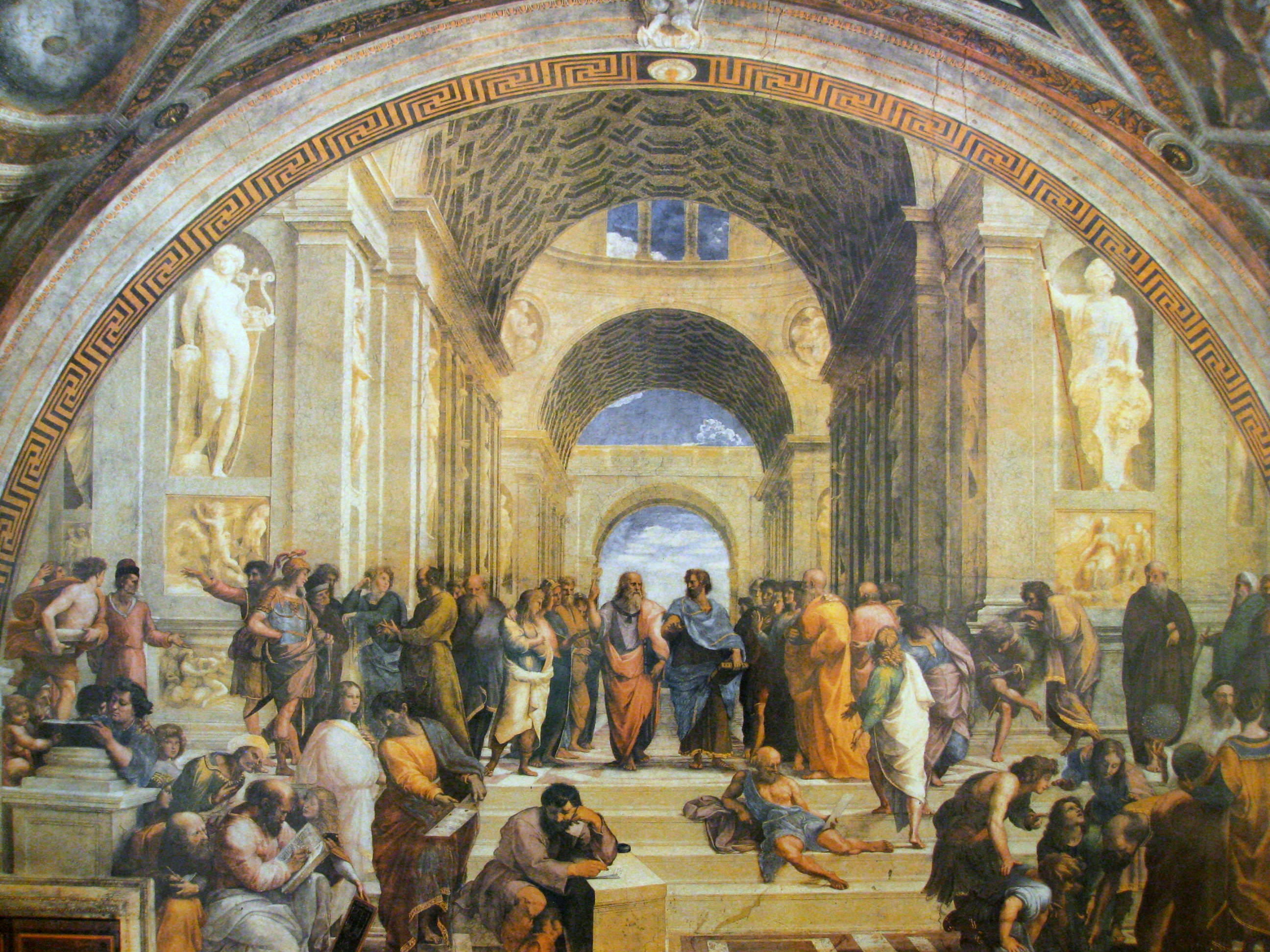
Plato’s Theory of Forms is a metaphysical explanation for how we can gain knowledge. Plato posits that every object and quality has a corresponding abstract ideal representing it. This ideal is called its Form, and it’s a single, unchanging, perfect essence of the property. In the world of Forms, there is an ideal, an essence, of beauty, justice, and creativity.
To better understand this, imagine a chair. Multiple chairs exists in our world, but the only one, unchanging essence of what a chair really is, exists in this world of Forms. A chair’s Form will encompass every essential and perfect quality the chair contains. And therefore, every chair in our world only resembles this perfect Form. Thus, we can only gain conceptual knowledge of chairs through reasoning about their function and constructing logically-sound arguments surrounding the Form.
Now imagine we apply this to the self. I am “Bee.” Every instance of me (in time) resembles and mimics a corresponding Form. The Form of Bee will contain every essential quality and characteristic of an instance of Bee; it’s an essence of Bee.
This essence, this perfect ideal, this Form, is what I imagine to be the Divine Self.
And using Plato’s guidelines, we can gain true knowledge of the Divine Self through our reasoning today.
Characteristics of the Divine Self
It is a culmination of everything; good and bad; moral and immoral.
Since the self has multiple expressions through our lifetimes, we can say the Divine Self is the Form of these expressions (previously established). That means every instance of the self must be a part of the overarching Form (Divine Self), just as every instance of beauty must be included in the Form of Beauty. Our moral systems and ethics cannot be applied to a Form of the self. Trying to apply our moral systems to the Form is like trying to confine the Form of Beauty with modern beauty standards. When in reality, Beauty is found in people, art, and every day pleasures, so Beauty must account for that with it’s underlying principles.
The Divine Self is a collection of the underlying principles that create your traits.
If you were to change completely tomorrow, transforming into a new person complete with different values, the Divine Self wouldn’t change. I feel this creates a grounded definition.
The Divine Self also includes social influence.
Some views (New-Age Spirituality mostly) suggest that you were your most authentic when you’re born, and sometimes even primal. Socialization is seen as an inhibition to your development, and only when you break out of it can you begin to receive magnetic benefits of being in alignment with the Divine.
However, per my view, social influence doesn’t matter to who you are. What matters is that you are expressing it. This fixes the “how would you know if your intentions were influenced?” problem.
The Divine Self is more logical and conscientious than primal.
The Divine Self must take into consideration goals and natural inclinations. Feeling unsatisfied or disappointed at certain outcomes hint at (basically) inherent values. Being “primal” or prioritizing short-term satisfaction, would lead to more unsatisfaction in the long term. The Divine Self is unable to feel this disatisfaction
Why Authenticity doesn’t exist.
I’ve concluded that being in alignment with the Divine is impossible, as it’s a Form, and no sensible earthly object can be in alignment with this Form.
If we define authenticity as being in alignment with the Divine Self, then it’s impossible to both be more or less ‘authentic.’
Imagine an infinite bride, with the authenticity (alignment) and inauthenticity (misalignment) at both ends. Since the bridge is infinite, a value of 1000 Authentic Points has no measurable difference along the bridge than 1 Authentic Point.
This solves the problem of defining what exactly is authentic in one’s self. The answer is: no one can… objectively.
What I’m having trouble with, and why this article is labeled “unfinished,” is how one can express the Divine Self.
Alignment may be impossible, but expression still is. Just as you cannot be the Form of Beauty, you can mimic and participate in Beauty’s Form.
Perhaps expression is something in alignment with Nietzsche’s master morality— constructing your own values, holding onto them tightly, and never holding back your will to power. In practice, I actually don’t think this is a bad option. It can be used to justify great misery, but for most people, that just wouldn’t be the case. Most people don’t have any urge to commit gruesome crimes, as they have empathy and/or understand the consequences of their actions, so master morality would look more like:
confidence; never ashamed or embarrassed of your actions
awareness of intentions and values
no guilt or pity
construction of your own positive values, rather than adopting some from external social/religious structures — promoting self-esteem
Truthfully, I was going to make a video covering this topic, but I got stuck here with this expression and feel as though I can’t continue with it now.
Thought Experiments
Was Hitler’s Divine Self the (failed) artist, or the genocidal dictator?
I use Hitler as a thought experiment to exemplify how quick other views have been to excuse horrific behavior, saying it “isn’t really them.”
Humanistic psychology holds the belief that all humans are intrinsically good, and therefore, the original, Higher Self, must be in alignment with that good. In this case of humanistic psychology, Hitler’s Divine Self must be the failed artist.
In this case, Hitler’s Divine Self must be the failed artist.
Under my thesis of Forms, Hitler’s Divine Self would be neither of these choices, but the underlying principles that make both of these paths possible.
Augustine teaches that evil does not have its own substantive existence but is a privation of the good. This being the case, the "Divine Self" would not include any immorality or "bad," and would be expressed by practicing correct action. It is actually possible to do this, albeit extraordinarily difficult and rare. It would take maximum attention and consideration for oneself and others, and a position of openness, confidence, and humility which you also spoke about. Interested in your thoughts.
Very good intuition here. You might like the work of Jung.